
Northport Directory Runs by Year
The Alabama Department of Archives and History city-directory finding aid gives the firmest year list for Northport research. Its early titles say Tuscaloosa, yet the surviving 1922 sample proves that Northport names occur inside them. The archive later uses combined Tuscaloosa and Northport titles, followed by countywide books. Tuscaloosa Public Library confirms a separate local shelf, but its website does not publish a volume-by-volume list. Ask staff before planning a trip around one edition.
| Collection | Years represented | Where held | Access |
|---|---|---|---|
| Tuscaloosa microfilm | 1913-1932 | ADAH Reference Room | In person; confirm reel gaps |
| Tuscaloosa printed volumes | 1913-1973, selected editions | ADAH boxes 184-187, 201 | In person |
| Tuscaloosa & Northport | 1974-1997, selected editions | ADAH boxes 125, 187, 188, 201, 202 | In person |
| Tuscaloosa County | 1999-2003 | ADAH boxes 125, 215, 229 | Verify Northport entries in each volume |
| Northport and Tuscaloosa shelf | Years not listed online | Tuscaloosa Public Library Archives | Reference Desk access |
The Northport archive list contains gaps, and a missing year is only a holdings gap. It does not prove that no Northport book was issued. One entry in the official PDF appears as “163,” likely an omitted “19,” but the source typo should remain unresolved until staff check the volume. No verified final print year or complete local reverse-directory run was found.
Northport Names Under Tuscaloosa
A cover-title search can miss Northport residents. Alabama Memory's 1922 R. L. Polk directory page is headed as a Tuscaloosa city directory but includes many Northport people and businesses. By contrast, the ADAH inventory does not begin titles that explicitly name both cities until 1974. That decades-long title lag makes the locality within each entry more useful than the cover alone.
The 1922 Northport page is the strongest digitized sample. It should be searched alongside spelling variants and nearby surnames, not treated as a complete book index. A researcher seeking Northport city directories before 1974 should open Tuscaloosa editions, scan the alphabetical run, and note entries whose residence is simply “Northport.”
The digitized Polk source shows that embedded Northport entries are real.
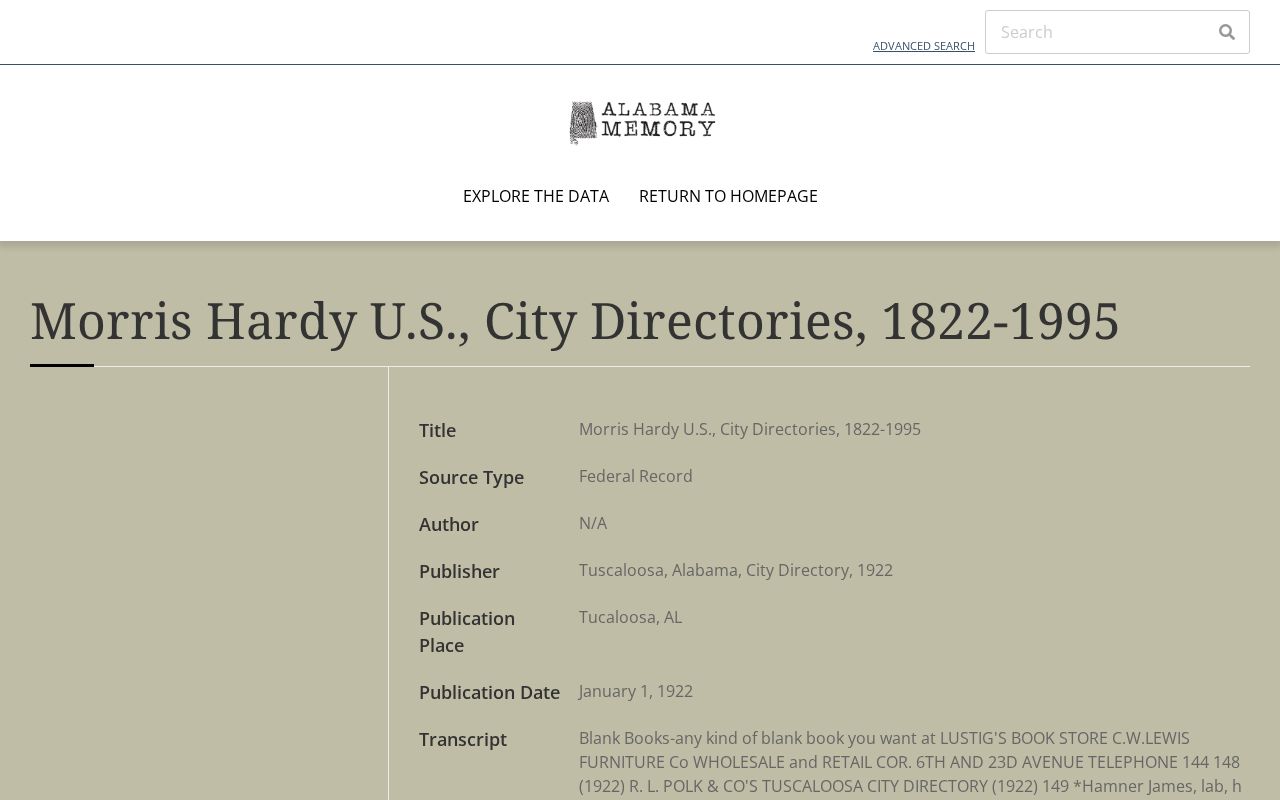
Its page layout also shows why adjacent entries, locality labels, and the volume key matter when one line is abbreviated.
Decode a Northport Directory Entry
The inspected Polk page puts surnames first, then given names and initials. A spouse may appear in parentheses. Short forms compress occupations and employers, while h marks a home or residence and r means resides or rooms. The word same points back to the prior address. Many Northport lines provide no house number at all, so they prove a local tie but not a specific parcel.
| Name order | Surname first, followed by given name and initials |
|---|---|
| Spouse | Name in parentheses; not a full household roll |
| Work clue | Short occupation or employer terms such as bookkeeper, clerk, or grocer |
| Residence | h, r, or locality-only “Northport” |
| Widow note | wid plus the deceased spouse, which narrows later death research |
| Business line | Business name, proprietor, and locality may be interfiled |
A leading asterisk appears on some Northport lines, but the isolated image lacks the key. Never assign it a meaning without viewing the front matter. Alabama Memory also labels the item a “Federal Record,” though it is a commercial directory. Treat that phrase as catalog metadata, not the source's legal character.
- Criss-cross directory
- A later directory arranged by address or street rather than only by surname. No authoritative Northport run was verified.
- Householder index
- A street-order list of named householders, when a volume actually contains one.
- Abbreviation key
- The publisher's legend for short forms and symbols. Copy it before interpreting an entry.
Northport Directory Research at TPL
Tuscaloosa Public Library's Archives and genealogy service is on the second floor. Researchers sign in at the Reference Desk, where staff provide Archive and microfiche access. The same desk gives access codes for genealogy computers. This is the practical stop for Northport city directories, yearbooks, cemetery and funeral files, Tuscaloosa News holdings, local maps, tax sources, and church or family histories.
Some Northport digital sources are library-only. Ancestry Library Edition is available inside TPL branches. HeritageQuest supplies primary and local-history sources, while TPL's FamilySearch affiliate status can open some images unavailable through a normal home account. Black-and-white printing is listed at $0.10 and color at $1.00. Bring Northport name variants, rough dates, and old addresses so staff can route the search across both physical and digital collections.
Northport's record geography crosses the Black Warrior River. The people sought may have lived in Northport, while the books, courthouse files, TPL history desk, and university map collections sit in Tuscaloosa.
Trace Northport Families Across Editions
A Northport city directory works best as a sequence. One line supplies a spelling, spouse, work clue, or locality. Adjacent editions reveal whether the facts persist. Census schedules, maps, deeds, obituaries, and probate then test what changed. Public federal censuses now run through 1950 under the 72-year release rule.
- Search both Tuscaloosa and Northport titles, including books whose covers omit Northport.
- Copy the full entry, title page, edition year, locality, spouse, occupation, employer, address, symbols, and key.
- Move to the nearest earlier and later editions. Track new addresses, altered work, and the first widow notation.
- Pair the directory years with public federal censuses from 1910 through 1950 and Alabama state census sources for 1850, 1855, and 1866.
- Close the gap with a newspaper, funeral or cemetery file, deed, or probate record rather than guessing why a name vanished.
Disappearance can mean a move, death, an unlisted household, or a missing edition. A spouse or employer often separates same-name residents. When only “Northport” appears, a census location, deed description, or tax source may supply the address. Modern address work belongs in the Northport street directory, while these books own the historical shelf.
The National Archives census guide explains the public release cycle used with directory years.
The census can add all household members, ages, birthplaces, and work details that a commercial directory often omits.
Map Northport Directory Addresses
Maps can turn a vague city directory line into a place. The University of Alabama Historical Map Archive has a 1919 Map of Northport at a detailed 1:2,500 scale, plus an 1887 land-company map and county maps from 1912, about 1920, and 1928. UA aerial coverage spans 1938, 1956, 1967, 1974, 1978, 1981, 1992, and 1999.
No Northport-titled Sanborn set was verified. UA lists Tuscaloosa fire-insurance editions from 1884 through 1910, but those titles must not be assumed to cross the river. The 1919 Northport map and later aerials are the safer bridge. Tanyard Street also became 10th Street, so a historical hit needs both names.
The University of Alabama digital collections provide another route into local maps and archival images.
Visual sources confirm where a street or structure stood, but they do not identify an occupant without a directory, census, deed, or tax record.
Extend Northport Directory Clues
TPL's yearbooks can place a former student by school, class, activity, and photograph. Its Tuscaloosa Files index points toward cemetery articles, grave lists, church histories, centennial books, and historic census materials. The Northport Spectator, published from 1870 to 1873, is noted in city history, though no verified online run was found. Ask TPL and ADAH about newspaper access.
A practical death trail runs from the last directory appearance to a new widow notation, then to newspaper, funeral, cemetery, and probate sources. FamilySearch's Alabama county marriage and probate collections may provide indexed, imaged, or browse-only material. TPL affiliate access can matter when an image is restricted at home.
Northport records may also survive outside an expected index. Tuscaloosa Genealogical Society volunteers began with cases from 1923-1950, then found 1889-1916 circuit files in a courthouse attic. More than 2,350 volunteer hours produced an index, but duplicate case numbers, incomplete files, and film omissions remain. A failed Northport result calls for the index, microfilm, and custodian, not a claim that the record never existed.
Note: A directory entry is evidence for a time and place, not proof of every household member or a precise parcel. Verify each clue.
Search Northport's Earlier Names
Historical index terms include Kentuck or Canetuck, North Tuscaloosa, North Port, and Northport. The University of Alabama place-name reference dates the post office to 1832 and gives incorporation as 1852, while the current city history and Encyclopedia of Alabama give 1871. Preserve that conflict until primary incorporation records settle it.
The surviving Northport directory sequence has four useful milestones:
| 1913 | Earliest year held in ADAH's Northport-relevant Tuscaloosa run, not a proven first publication. |
|---|---|
| 1922 | Digitized R. L. Polk sample confirms Northport names within a Tuscaloosa title. |
| 1974 | First ADAH title in the inventory to state Tuscaloosa & Northport. |
| 1999 | Countywide title begins in the listed holdings, continuing through 2003. |
Northport's river, road, and rail eras make work clues especially useful. Cotton and river commerce, the 1901 rail arrival, later university links, health care, and manufacturing all shaped movement. These are search leads, not proof about any one resident. Test them against the occupation field, spouse, address, birthplace, and the next edition.
The 1932 tornado killed 38 people and heavily damaged Northport. A household move or disappearance around that year may reflect displacement, but only another source can confirm it. Rapid growth also means newer outer addresses may never appear in downtown-era city directories.