
Northport Address History Sources
Past residents are best traced by period. Modern work starts with the current assessment and the county's name-indexed deed portal. Older work shifts to direct and reverse deed books, printed directories, public census schedules, maps, and local archives. Each source can fill a gap, but only a household source supports who lived there rather than who held title.
| Source | Years it covers | Where held | What it shows |
|---|---|---|---|
| General recorded-document search | March 20, 1975 to current | Tuscaloosa County Probate online | Name-indexed deeds and document images |
| Historical deed indexes | Before March 20, 1975; exact portal start unstated | Probate Historical Indexes | Direct seller and reverse buyer references |
| Microfilmed deed books and index | Deeds 1823-1901; index 1818-1904 | FamilySearch catalog and archival access | Early ownership and legal descriptions |
| City directories | Verified ADAH holdings from 1913 through 2003, with gaps | ADAH and Tuscaloosa Public Library | Names, spouses, work clues, and address or locality |
| Federal census | Named households through 1950 | NARA and library databases | Household members and census-date details |
| Maps and aerials | Northport map in 1919; area aerials 1938-1999 | University of Alabama Map Library | Street, lot, and built-landscape change |
Start with the newest trustworthy key. A parcel number or legal description is more durable than a street label. Then choose the source closest in time to the prior resident being sought.
Trace Northport Past Residents Backward
The modern tax roll supplies a lead, not a final answer. Tuscaloosa County taxes run a year in arrears, so a bill may still show the seller after a transfer. Search the county Basic Search by physical address, record its parcel identifiers and current owner lead, and then test that name in the Probate deed system.
- Record the parcel PIN or number, physical address, subdivision or district, acreage, value, and roll owner.
- In the Probate Records Search, choose DEEDS and search the owner as `Last Name First Name`.
- Open the acquisition deed. Match the legal description, parcel, subdivision, plat book and page, or source-of-title reference.
- Take the seller's name and search that person as an earlier buyer. Repeat the transfer chain one deed at a time.
- Before the online cutoff, choose HISTORICAL INDEXES, select DEED and a dated BOOK, then use Direct for a seller and Reverse for a buyer.
The source-of-title rule is especially useful. Tuscaloosa County requires a conveyance to cite the deed book and page where the seller obtained title. That reference can reveal the next backward link without a broad same-name search.
- Grantor and grantee
- The grantor transfers property; the grantee receives it.
- Chain of title
- The linked sequence of recorded transfers for the same land.
- Legal description
- The deed's land identity, often by subdivision lot and plat or by metes and bounds, rather than a postal address.
- Direct and reverse index
- Direct organizes sellers or grantors; reverse organizes buyers or grantees.
Northport Past Residents Before 1975
The county's general name search stops at March 20, 1975, but previous-resident work does not stop there. Historical Indexes remain inside the same free-account system. Their dated book choices point to older deed references, and courthouse copies provide the underlying instrument when an image or index is unclear. Search and document viewing are free after account creation.
For much earlier Northport property, the FamilySearch catalog describes deeds from 1823 to 1901 and an index spanning 1818 to 1904, filmed from courthouse originals in 1989. The Alabama Department of Archives and History county microfilm database offers another route by county and record type. A Northport address may not appear in its modern form, so follow the legal tract, parties, book and page.
Copies can also be requested from Probate Records & Recording at 714 Greensboro Avenue, Room 137. Regular deed copies are $1 per page, with $3 added for certification. Mail submissions need a self-addressed envelope, and the recording line and recording email offer direct fallback channels.
Translate Northport Past Resident Addresses
Before looking for previous residents, test whether the address once had another name. The Palmer house provides a documented local bridge: the 1907 home stood on Tanyard Street, now 10th Street. Search both versions in directories, newspapers, deeds, and map catalogs. Also test Northport's older place labels, including Kentuck or Canetuck, North Tuscaloosa, and North Port.
Northport Planning & Inspections can bridge a formal change. Its address form records a parcel ID, subdivision and lot, owner mailing address, request type, and the street faced by the front door on a corner lot. No searchable history of every request was found. A focused email request should therefore include modern and old labels, parcel ID, subdivision, and an approximate period.
Note: Keep a dated address-variant list beside the deed chain so a renamed Northport street does not look like a household move.
Map Northport Past Residents Safely
The University of Alabama inventory lists Tuscaloosa Sanborn fire-insurance editions from 1884 through 1910, but it does not list a Northport-titled set. Do not assume those sheets cross the Black Warrior River. The sound Northport substitute is the 1919 town map, supplemented by an 1887 land-company map and county maps from 1912, about 1920, and 1928.
The Tuscaloosa Sanborn inventory shown below is useful mainly for defining that coverage limit.
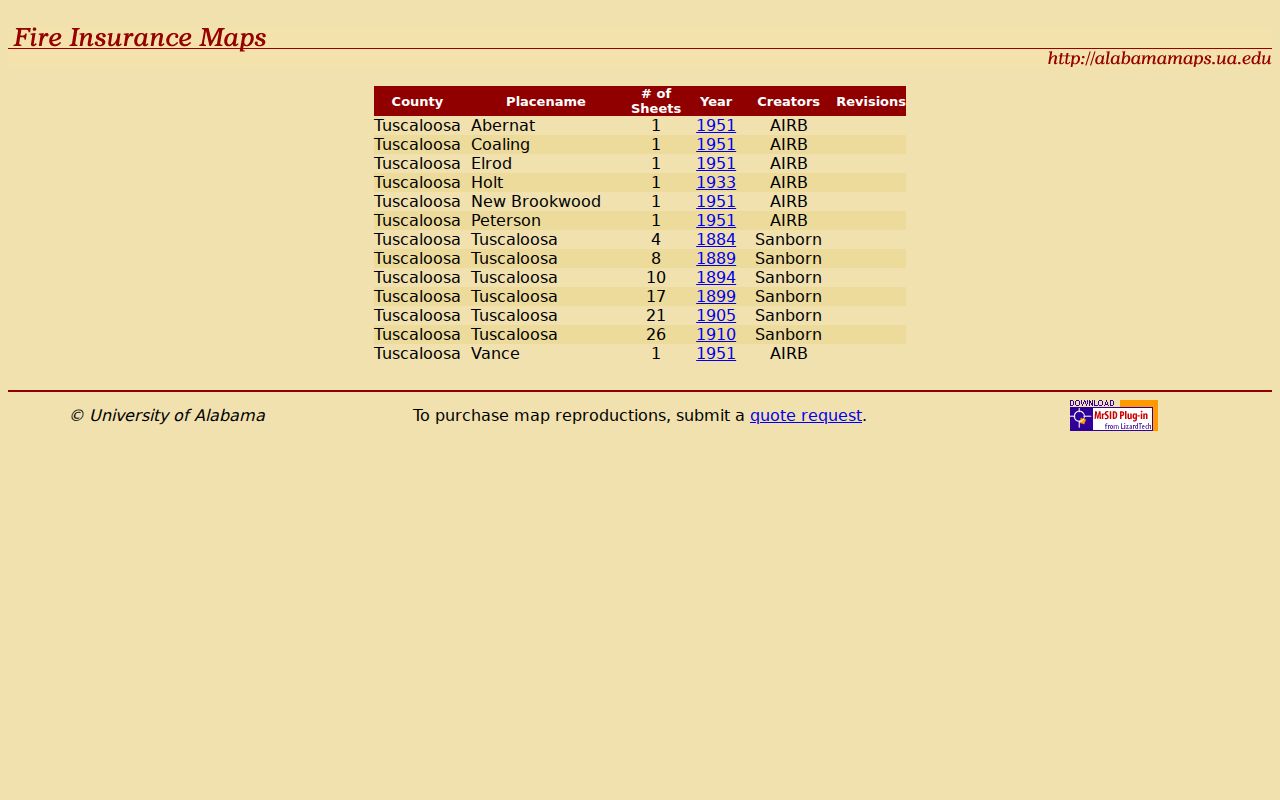
The absence of a Northport title redirects the address trail toward the 1919 Northport map and the UA collections rather than supporting an unverified sheet claim.
Northport Aerials Date the Landscape
Aerial photographs cannot name previous residents. They can show whether a house, road, subdivision, or nearby landmark existed at a given point. UA's inventory lists Tuscaloosa-area coverage in 1938, 1956, 1967, 1974, 1978, 1981 infrared, 1992, and 1999. Those dates create a useful frame around directory, deed, or census findings.
The University of Alabama aerial archive pictured here is the source for that sequence.

If a building appears between two flights, search the same span for a deed, subdivision plat, address request, or responsive permit file. That narrows the work without assigning a person to the property on visual evidence alone.
Northport Previous Residents in Households
Ownership is only half of address history. A directory entry, census schedule, obituary, or probate file can connect people to the place. The 1922 R. L. Polk volume is titled for Tuscaloosa but includes many Northport residents. Some entries show only “Northport,” so a name, spouse, work clue, deed, and map may be needed before a household can be assigned to one house.
- Transcribe each directory entry exactly, including spouse, work, `h` for home, `r` for residence or room, widow notation, address, and locality.
- Check the available edition immediately before and after it. A changed spouse, occupation, address, or widow notation can separate same-name residents.
- Pair the directory period with the nearest public census. Named federal household schedules are open through 1950 under the 72-year rule.
- Compare census street, household members, age, birthplace, occupation, and home details to the directory and deed evidence.
- Carry a death or departure clue into newspapers, funeral and cemetery files, then probate for heirs, estate papers, and a final address.
The full year runs and entry conventions are treated on the Northport directory book page. For address history, the vital task is matching the household to the same place across sources.
Northport Research Crosses the River
Northport's previous residents often appear in collections held in Tuscaloosa. The Tuscaloosa Public Library Archives and genealogy service sits on the second floor. Visitors sign in at the Reference Desk for Archives access, the microfiche machine, and codes for genealogy computers. The physical shelves include Northport and Tuscaloosa directories, maps, census material, local yearbooks, cemetery and funeral records, tax sources, and the Tuscaloosa News.
Some digital access is also building-bound. Ancestry Library Edition and enhanced FamilySearch affiliate access must be used inside TPL branches. Bring names, approximate dates, every known address variant, parcel details, and time to work in both the physical Archive and the computer resources. Staff keep the detailed school-by-school yearbook list at the desk rather than online.
This geography is normal. Northport is not the county seat, so courthouse, library, archive, and university materials across the river form one records ecosystem with the Northport property.
Missing Northport Cases May Survive
A failed web search does not prove a record was lost. Tuscaloosa Genealogical Society volunteers began indexing circuit loose records expected to cover 1923 through 1950. They then found cases from 1889 through 1916 in the courthouse attic. More than 2,350 volunteer hours produced an index with complainants, respondents, case type and date, other named people, and relationships.
Some files were incomplete. Numbers were duplicated, and some indexed cases were absent from film. Search the ADAH loose-record index shown here, then check TPL or ADAH film and ask the courthouse about the file.
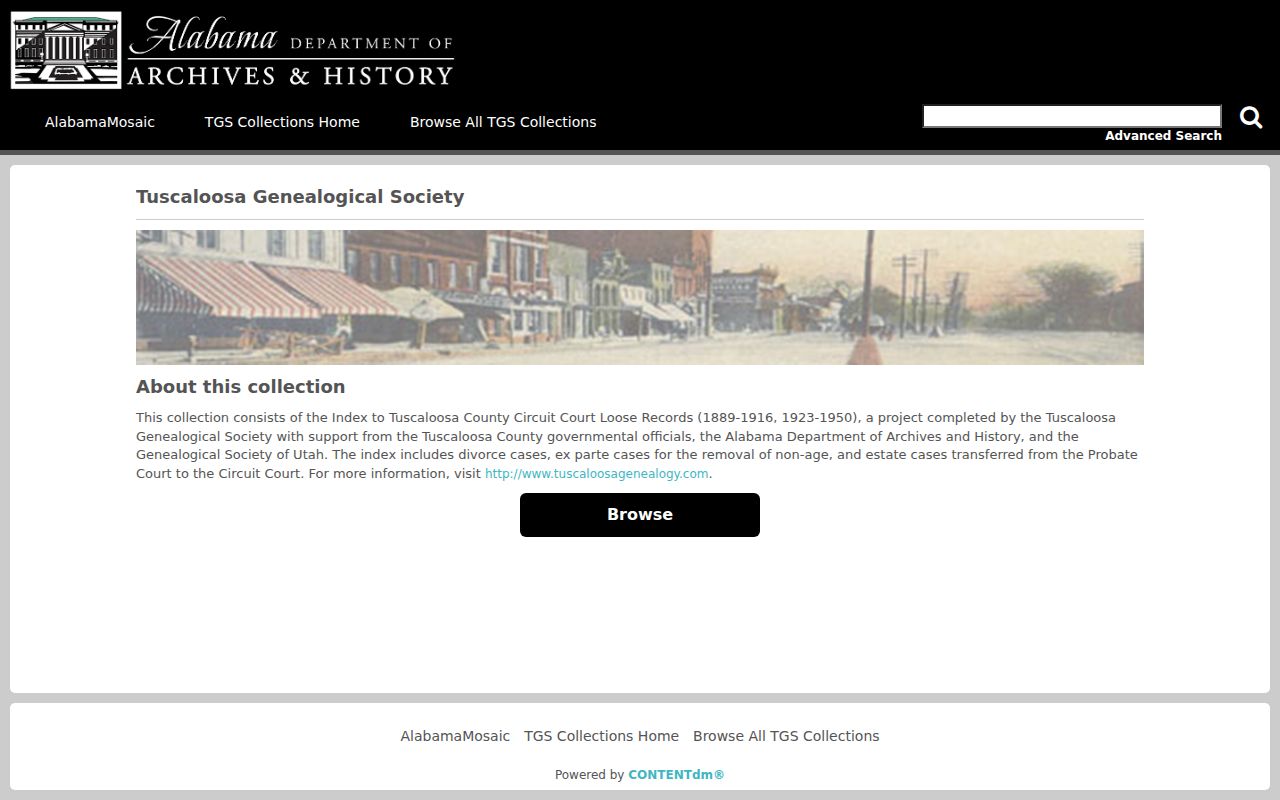
This local survival story is a warning against equating “not online” with “destroyed.” A case involving an estate or family relationship may still extend the Northport address trail.
Confirm Northport Past Residents
End with a small proof set for each person: one source for the land, one for the household, and one for time. A deed plus a directory entry plus a census or obituary is far stronger than a matching surname alone. Preserve citations, image or book numbers, page numbers, address variants, and the date each record describes.
Watch the gaps. Most 1890 federal schedules were destroyed in a national fire. ADAH's directory holdings contain missing years. A tax bill may lag a sale. Aerial photographs show buildings, not occupants. These limits should remain visible in any family or house history.
Lawful use. Research Northport previous residents for house history, genealogy, heir questions, or personal curiosity. Never use a living person's address trail to stalk, harass, intimidate, or cause harm.
When a living person is protected by an Alabama confidentiality program or a record is closed, stop at the lawful boundary. Historical curiosity never overrides safety or access restrictions.